Construction companies need to know where their equipment is, how it is being used and whether it has moved without authorization. The right construction equipment tracking system can provide this visibility across jobsites, storage yards and customer locations.
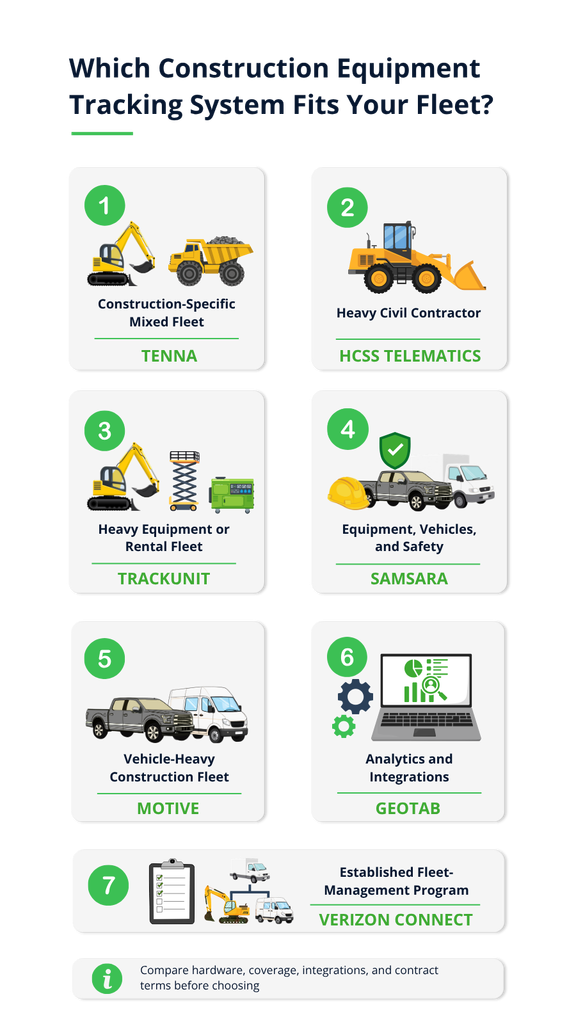
In 2026, Tenna is one of the strongest options for construction-specific mixed fleets, while Samsara is well suited to companies that want equipment, vehicle and safety data in one platform. HCSS Telematics stands out for heavy civil contractors, Trackunit for heavy equipment and rental fleets, Geotab for analytics, Motive for vehicle-heavy operations and Verizon Connect for established fleet-management programs.
The best choice depends on whether you need to track powered equipment, trucks, trailers, attachments or smaller tools. Location-update frequency, telematics data, connectivity, integrations and hardware requirements also vary considerably between platforms.
This guide compares seven leading construction equipment GPS tracking systems, explains where each one fits and provides a practical framework for choosing the right option for your fleet.
Quick Comparison of the Best Construction Equipment Tracking Systems
The right system depends on your fleet and the information you need from it. Use this comparison to identify the strongest candidates for a closer evaluation.
| System | Best For | Main Strength | Potential Trade-Off |
|---|---|---|---|
| Tenna | Construction mixed fleets | Tracks vehicles, equipment, trailers and smaller assets | May offer more functionality than basic tracking requires |
| Samsara | Connected fleet operations | Combines equipment, vehicles and safety data | Broader platform and hardware can increase complexity |
| HCSS Telematics | Heavy civil contractors | Detailed machine and utilization data | Best fit may be companies using the HCSS ecosystem |
| Trackunit | Heavy equipment and rental fleets | Construction-focused equipment connectivity | Data can vary by device and OEM connection |
| Geotab | Data-intensive vehicle fleets | Analytics and integration flexibility | Some equipment coverage may require third-party products |
| Motive | Vehicle-heavy construction fleets | Combines driver safety and equipment monitoring | Less specialized around heavy machinery |
| Verizon Connect | Established fleet programs | Vehicle tracking, utilization and maintenance | Device capabilities and reporting frequency can vary |
Tenna, HCSS Telematics and Trackunit have the strongest construction-specific positioning. Samsara, Motive and Verizon Connect are particularly relevant when road vehicles are a major part of the fleet, while Geotab stands out for analytics and extensibility.
Capabilities vary by hardware, subscription and region. Verify each provider against your actual equipment before making a final selection.
What Is Construction Equipment Tracking?
Construction equipment tracking uses GPS devices, sensors and software to monitor the location, movement and activity of equipment across jobsites, yards and customer locations.
A tracker attached to the asset determines its location and sends that information through a cellular or satellite network to a cloud-based platform. Fleet managers can then view equipment locations, movement history and alerts from a central dashboard.
Basic GPS tracking shows where an asset is located. More advanced telematics systems can also collect:
- Engine hours
- Mileage and idle time
- Fuel consumption
- Equipment utilization
- Diagnostic fault codes
- Maintenance information
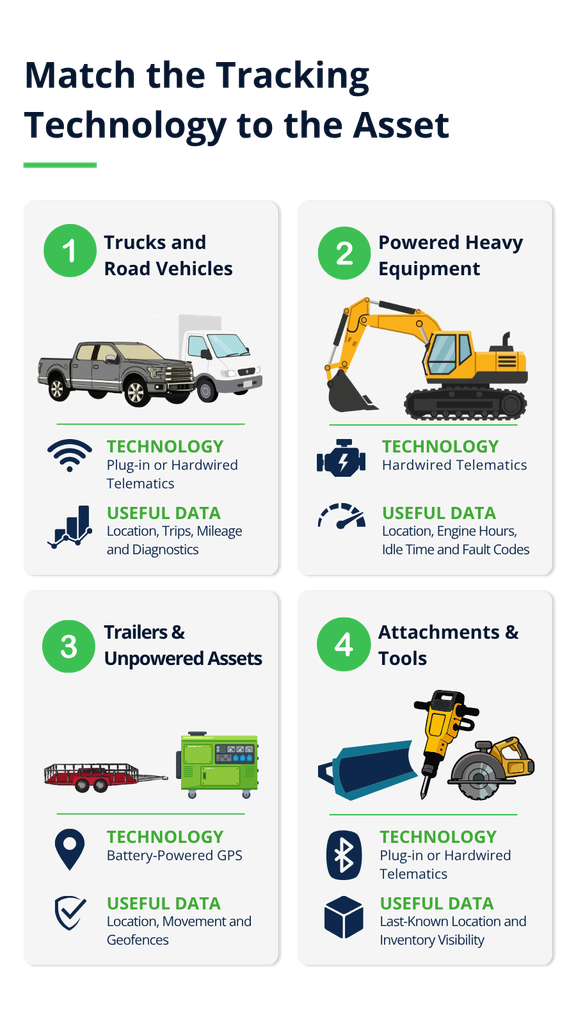
The data available depends on the equipment and tracking hardware. Hardwired devices can often collect detailed information from powered machines, while battery-powered trackers and Bluetooth tags are better suited to trailers, attachments and smaller assets.
GPS tracking, asset tracking and telematics are related but not identical. GPS primarily identifies location, asset tracking can use several technologies to monitor different asset types, and telematics adds operational data about how a vehicle or machine is performing.
How We Evaluated Construction Equipment Tracking Systems
We evaluated each system using publicly documented capabilities rather than hands-on product testing. Because features can vary by hardware, subscription and region, buyers should confirm all requirements directly with the provider.
Our comparison focused on six criteria:
- Fleet coverage: Support for trucks, powered equipment, trailers, attachments and smaller assets.
- Location tracking: Reporting frequency, movement history, geofences and unauthorized-movement alerts.
- Equipment telematics: Access to engine hours, mileage, idle time, fuel information and diagnostic data.
- Hardware and connectivity: Availability of hardwired, plug-in, battery-powered and Bluetooth devices, along with cellular or satellite connectivity.
- Integrations: Options for sharing data with maintenance, rental, accounting, ERP or construction-management systems.
- Implementation: Installation requirements, training, support, contracts and ongoing device maintenance.
The best system is not necessarily the one with the longest feature list. It is the platform that can collect the right information from the company’s actual equipment and make that data useful for daily operations.
The 7 Best Construction Equipment GPS Tracking Systems for 2026
1. Tenna: Best for Construction-Specific Mixed Fleets
Tenna is an equipment management platform built for construction companies with mixed fleets. Its hardware options can track trucks, heavy machinery, trailers, attachments and smaller assets within one system.
Depending on the device, Tenna can provide GPS location, movement history, geofences, engine hours, utilization data and maintenance information. Hardwired telematics devices support powered equipment, while battery-powered trackers and Bluetooth technology extend coverage to unpowered and smaller assets.
Tenna’s main advantage is its construction focus. It treats heavy equipment and attachments as core fleet assets rather than secondary additions to a vehicle-tracking platform. This makes it a strong option for contractors that want visibility across several equipment categories.
However, its wider equipment-management, safety and maintenance capabilities may be more than a company needs for basic location tracking. Buyers should ask Tenna to match its hardware to their actual fleet and confirm the reporting frequency, installation requirements and cost for each asset type.
Learn more from Tenna’s construction equipment GPS tracking overview.
2. Samsara: Best for Unified Equipment, Vehicle and Safety Data
Samsara combines GPS tracking, equipment monitoring, vehicle telematics and driver safety in one connected operations platform. It is well suited to construction companies that want to manage road vehicles and equipment together.
Hardwired gateways can collect location and engine-hour data from powered equipment. Battery-powered devices and asset tags can track trailers, generators, containers, tools and other assets without permanent power.
Samsara supports real-time location tracking, geofences, utilization reporting, movement alerts and preventive maintenance based on equipment usage. Companies can also connect this information with vehicle diagnostics, driver activity and video telematics.
The platform’s broad scope is its primary advantage and potential drawback. It can consolidate several areas of fleet operations, but companies seeking simple GPS tracking may not need its wider safety and telematics capabilities.
Buyers should confirm which devices and subscriptions are required for each asset type, along with contract terms, installation costs and reporting frequency.
Learn more from Samsara’s equipment-tracking overview.
3. HCSS Telematics: Best for Heavy Civil Contractors
HCSS Telematics provides detailed equipment and vehicle data for heavy civil and infrastructure contractors. Depending on the machine and hardware, it can track GPS location, engine runtime, mileage, idle time, fuel consumption, diesel exhaust fluid levels and diagnostic fault codes.
This operational detail helps contractors identify underused equipment, monitor idle time and schedule maintenance using actual machine activity. Companies using other HCSS products may also connect telematics information with equipment maintenance, job costing and field operations.
The platform is particularly valuable when a contractor needs more than basic location tracking. However, the data available can vary by equipment manufacturer, model year and connection type. Companies outside the broader HCSS ecosystem should also confirm how much standalone value the telematics product provides.
Before selecting HCSS, provide a sample equipment list and ask which data points can be collected from each machine, what hardware is required and which capabilities depend on other HCSS products.
Learn more from the HCSS construction equipment tracking overview.
4. Trackunit: Best for Heavy Equipment and Rental Fleets
Trackunit is a construction-focused telematics platform for contractors, equipment manufacturers and rental companies. It can combine data from Trackunit hardware, supported OEM systems and other connected sources to provide one view of a mixed equipment fleet.
Its capabilities include GPS location, movement status, geofences, engine hours, utilization, equipment-health information and maintenance planning. Trackunit also offers Bluetooth-based tracking for tools, attachments and other assets that do not require a dedicated GPS device.
The platform’s focus on connected construction equipment makes it particularly relevant for fleets containing machines from several manufacturers. It can reduce the need to check separate OEM telematics portals when the required connections are supported.
However, the available data varies by asset. A connected machine may provide engine and diagnostic information, while a Bluetooth-tagged attachment may only show its last reported location. Buyers should confirm regional network coverage, supported OEM connections and the information available from each proposed device.
Learn more about the Trackunit connected-equipment platform.
5. Geotab: Best for Analytics and Integration Flexibility
Geotab is a fleet telematics platform known for its analytics, reporting and integration ecosystem. It is best suited to construction companies with vehicle-heavy fleets or more advanced data requirements.
The Geotab GO device collects GPS location, trip history, engine information, fuel usage, idle time and driver activity from supported vehicles. This information appears in MyGeotab, where fleet managers can create reports, dashboards, geofences and maintenance reminders.
Geotab’s marketplace and integration tools are its primary strengths. Companies can extend the platform with third-party hardware and software or connect fleet information with other business systems.
However, tracking trailers, attachments and unpowered equipment may require marketplace products rather than Geotab hardware alone. This can introduce additional vendors, support responsibilities and costs.
Buyers should ask which capabilities are native to Geotab, which depend on third-party products and whether every asset will appear within one consistent interface.
Learn more from Geotab’s construction fleet-management overview.
6. Motive: Best for Vehicle-Heavy Construction Fleets
Motive combines vehicle telematics, driver safety and equipment monitoring in one platform. It is a strong option for construction companies that operate a large number of trucks but also need to track trailers, machinery and other assets.
Its Vehicle Gateway collects location and telematics data from trucks, while the Asset Gateway can monitor powered and unpowered equipment. Available capabilities include real-time GPS tracking, geofences, movement alerts, equipment utilization, fuel monitoring and maintenance information.
Motive’s main advantage is the connection between vehicle safety and equipment visibility. Companies can monitor drivers, vehicles and mobile assets without relying on completely separate systems.
However, equipment-heavy fleets should compare Motive’s machine data with platforms built specifically around construction equipment. The amount of information available will also vary between a connected vehicle, powered machine and battery-tracked asset.
Buyers should confirm what data can be collected from each equipment category and which hardware, subscriptions and contract terms are required.
Learn more from Motive’s construction fleet-management overview.
7. Verizon Connect: Best for Established Fleet-Management Programs
Verizon Connect provides GPS tracking for vehicles, heavy equipment and other mobile assets. It is best suited to established construction companies that want location data alongside utilization, driver activity and preventive maintenance.
Depending on the hardware, the platform can provide near-real-time location, movement history, jobsite geofences, engine hours, idle time, fuel information and maintenance alerts. Different devices are available for powered and unpowered assets.
Verizon Connect’s fleet-management experience makes it particularly relevant for companies with a substantial number of trucks and road vehicles. It can also help locate heavy machinery, identify underused assets and schedule service using engine hours.
However, its vehicle and equipment products do not necessarily provide the same reporting frequency or telematics detail. Buyers should confirm the data available from every proposed device, along with hardware costs, installation requirements and contract terms.
Learn more from Verizon Connect’s construction fleet-tracking overview.
Which Construction Equipment Tracking System Is Best for Your Fleet?
The best construction equipment tracking system depends on what you operate and what decisions the data must support. Start by grouping your fleet into vehicles, powered equipment, trailers, attachments and smaller tools.
Match the Technology to the Asset
Road vehicles typically require frequent GPS updates, trip history and engine diagnostics. Powered heavy equipment may need engine hours, idle time, fuel data and fault codes. Trailers often use battery-powered GPS devices, while attachments and smaller tools may only require Bluetooth tags.
Do not assume one device will work equally well for every asset type. Ask each provider to recommend hardware for a sample of your actual equipment.
Prioritize the Problem You Need to Solve
For theft prevention, focus on geofences, after-hours alerts, tamper resistance and reporting frequency.
For utilization, look for reliable engine hours and reports that distinguish productive work from idle time.
For maintenance, confirm that usage data can trigger service activity rather than simply displaying engine hours on a dashboard.
That information becomes more useful when it feeds a documented rental fleet maintenance process that accounts for work orders, parts, technicians and upcoming reservations.
For mixed-fleet visibility, verify that vehicles, machines, trailers and smaller assets can appear in one searchable view.
Confirm Reporting Frequency and Connectivity
“Real-time tracking” can mean different things between devices. Hardwired trackers may report every few minutes, while battery-powered units may check in less frequently to conserve power.
Ask what happens when equipment leaves cellular coverage, whether data is stored until connectivity returns and how reporting frequency affects battery life.
Evaluate Integrations
Tracking data becomes more useful when it supports maintenance, dispatch, job costing or rental management. Confirm whether the platform offers standard integrations or an API, what data can be exchanged and how often it updates.
The right system should reliably collect the information your company needs without forcing employees to maintain another disconnected source of equipment data.
For rental businesses, that connection must extend beyond GPS coordinates. Learn how to connect location data with availability, custody and operational status in a complete construction equipment inventory system.
Questions to Ask During a Construction Equipment Tracking Demo
A product demonstration should show how the system would work with your equipment, not just present a preconfigured dashboard. Give each provider a sample asset list before the meeting and ask:
- Which device would you install on each asset type?
Include vehicles, powered equipment, trailers, attachments and smaller tools. - How frequently does each device report its location?
Confirm how movement and reporting settings affect battery life. - What happens outside cellular coverage?
Ask whether the device stores information until connectivity returns. - What telematics data can you collect from our machines?
Use actual manufacturers, models and model years to verify engine hours, fuel data and fault-code availability. - Can you combine OEM data with aftermarket trackers?
Confirm whether both sources appear in one platform. - Can usage data trigger maintenance activity?
Determine whether the system creates an alert, task or complete work order. - How does the platform connect with our other systems?
Review integrations and APIs for maintenance, rental, accounting, ERP or construction-management software. - What is the complete cost and contract commitment?
Include hardware, installation, subscriptions, connectivity, training, integrations, support and device replacement.
A provider should be able to answer these questions using your fleet and operating scenarios. If the demonstration remains generic, it may not reveal how well the system will perform in your environment.
GPS Tracking Is Not the Same as Equipment Rental Software
GPS tracking and rental management software solve different parts of equipment operations.
A construction equipment tracking system can show:
- Where an asset is located
- When it entered or left a jobsite
- How many hours it has operated
- Whether it moved without authorization
- When it may require maintenance
Rental software manages the commercial and operational records surrounding that asset, including availability, reservations, contracts, rates, deliveries, pickups, service and invoicing.
For example, GPS may confirm that an excavator is at a customer’s jobsite and has operated for 40 hours. It may not show which rental agreement it belongs to, when it is expected to return or whether the customer has been invoiced.
Rental companies receive the most value when tracking data connects with their wider business processes. RUX Rentals and Microsoft Dynamics 365 Business Central can manage the rental, service and financial records, while a GPS platform contributes location and equipment-usage data.
Learn more about managing the complete equipment lifecycle in our construction equipment rental software guide.
Frequently Asked Questions About Construction Equipment Tracking
What Is the Best GPS Tracker for Construction Equipment?
Tenna, HCSS Telematics and Trackunit are strong options for construction-specific fleets. Samsara, Motive, Geotab and Verizon Connect may be better suited to companies managing road vehicles alongside equipment. The best choice depends on asset types, reporting frequency, telematics requirements and integrations.
How Does GPS Tracking for Construction Equipment Work?
A device attached to the equipment determines its location and sends that information through a cellular or satellite network to a cloud platform. Managers can then view locations, movement history, geofences and available telematics data.
Can GPS Track Equipment Without a Power Source?
Yes. Trailers, attachments and other unpowered assets can use battery-powered GPS trackers or Bluetooth tags. These devices may report less frequently than hardwired units to extend battery life.
Can GPS Trackers Help Recover Stolen Equipment?
GPS trackers can alert companies to unauthorized movement and provide location information that may assist recovery. Geofences and after-hours alerts allow managers to respond more quickly, but no tracking system can guarantee recovery.
How Much Does Construction Equipment GPS Tracking Cost?
Costs can include hardware, installation, software subscriptions, connectivity, integrations and device replacement. Pricing varies by asset type and required data, so companies should request a quote separating one-time and recurring expenses.
What Is the Difference Between GPS Tracking and Telematics?
GPS tracking primarily monitors location and movement. Telematics adds operational data such as engine hours, mileage, idle time, fuel consumption and fault codes. The available information depends on the equipment and installed hardware.
Choose the Right Construction Equipment Tracking System
The best construction equipment tracking system is the one that fits your fleet and provides information your team can use.
Tenna, HCSS Telematics and Trackunit offer strong construction-specific capabilities. Samsara, Motive and Verizon Connect are well suited to companies managing vehicles alongside equipment, while Geotab stands out for analytics and integration flexibility.
Before choosing a platform, provide each vendor with a sample equipment list. Confirm the required hardware, available data, reporting frequency, implementation costs and contract terms for every asset category.
GPS tracking can improve equipment visibility, theft response, utilization and maintenance planning. Its value increases when location and usage data connect with rental management, service, accounting and other operational systems.
If disconnected systems are making it difficult to manage your equipment, customers and financial information, Service Dynamics can help you build a more connected rental operation with RUX Rentals and Microsoft Dynamics 365 Business Central. Contact our team to discuss your equipment-management requirements.